"I suppose it is tempting, if the only tool you have is a hammer, to treat everything as if it were a nail." - Albert Maslow
"If you don't have a hammer, you will treat everything as a hammer." - Me
Tuesday, July 16, 2013

Sunday, July 14, 2013
Contrasting Stories
This morning I was thinking about what the future of the US securities market was going to look like. I assume it will move to further automation. But how will regulation attempt to keep up with it? Then I saw this story
ThisDayLive: Ajomale: It is Absolutely Necessary for Nigeria to Have an OTC Market
My first thought was "Oh no. Should I expect to soon start receiving a flurry of emails from wealthy West African broker dealers offering to share with me their family's vast wealth of credit default swaps if only I will agree to novate those positions to my clearing account?"
On a more serious note - the story is an interview with the the CEO of the Nigerian Association of Securities Dealers (also known as NASD) about how Nigerian securities brokers are trying to set up an OTC market. From that story
"Most of the time people see a market as only a trading platform, but behind the trading platform are rules, in front of the rules are operators, behind all the transactions there must be a bank and for a transaction to run smoothly there must be a clearing house. So all these peripherals we have put them in place in addition to getting a platform."
So they are forced to think about all of the same issues that we face in the US and will continue to face as our securities market increases in its complexity. However contrast that story with this one in the same newspaper
ThisDayLive: Shekau Denies Boko Haram Ceasefire
This second story is about Boko Haram the militant Islamist movement that operates in the Northern Nigerian state of Yobe. The name Boko Haram means "Western education is sinful" or "Western education is forbidden". The group's primary activity seems to be blowing up schools and Christian churches. They could be considered to be the Taliban's West African cousin. Last week they massacred 29 school children. In a world filled with vile militant groups this is truly one of the most vile. In case you were wondering Nigeria has a population of approximately 170 MM people and a 61% literacy rate. Meaning they have approximately 66 MM illiterate persons.
But soon they may have an OTC securities market. I can't wait to start receiving those emails.
ThisDayLive: Ajomale: It is Absolutely Necessary for Nigeria to Have an OTC Market
My first thought was "Oh no. Should I expect to soon start receiving a flurry of emails from wealthy West African broker dealers offering to share with me their family's vast wealth of credit default swaps if only I will agree to novate those positions to my clearing account?"
On a more serious note - the story is an interview with the the CEO of the Nigerian Association of Securities Dealers (also known as NASD) about how Nigerian securities brokers are trying to set up an OTC market. From that story
"Most of the time people see a market as only a trading platform, but behind the trading platform are rules, in front of the rules are operators, behind all the transactions there must be a bank and for a transaction to run smoothly there must be a clearing house. So all these peripherals we have put them in place in addition to getting a platform."
So they are forced to think about all of the same issues that we face in the US and will continue to face as our securities market increases in its complexity. However contrast that story with this one in the same newspaper
ThisDayLive: Shekau Denies Boko Haram Ceasefire
This second story is about Boko Haram the militant Islamist movement that operates in the Northern Nigerian state of Yobe. The name Boko Haram means "Western education is sinful" or "Western education is forbidden". The group's primary activity seems to be blowing up schools and Christian churches. They could be considered to be the Taliban's West African cousin. Last week they massacred 29 school children. In a world filled with vile militant groups this is truly one of the most vile. In case you were wondering Nigeria has a population of approximately 170 MM people and a 61% literacy rate. Meaning they have approximately 66 MM illiterate persons.
But soon they may have an OTC securities market. I can't wait to start receiving those emails.
Saturday, July 13, 2013
Income of USD 200,000 doesn't make you rich (or smart)
Note to SEC: 200,000 Doesn't Mean You're Rich - James Grieff
"The Securities and Exchange Commission today approved an end to a long-standing rule that barred hedge funds and private investment groups from advertising to seek capital from the public...The 80-year-old ad ban placed limits on how certain funds could solicit money from the general public for "private placements" -- investment arrangements that are exempt from SEC registration rules and their accompanying financial disclosures...Although the SEC had to end the ban, it didn't have to leave intact outdated standards outlining which investors would be allowed to put money into private placements. For individuals, such "accredited investors" are still defined as those with annual incomes of USD 200,000 ( USD 300,000 for a couple) and a net worth of USD 1 million. To its credit, the agency two years ago decided to exclude a primary residence from the net worth calculation...Those thresholds were set in 1982, when USD 200,000 was worth a lot more than it is today. Thanks to inflation, you would need to make almost USD 500,000 a year to have the same standard of living."
A few years back I took the Series 24 exam to be a securities principle ie a person who supervises stock brokers and broker dealer firms. As I was reading through the virtual telephone book of rules I wondered which rules had been violated that led to the 2007-2008 meltdown. The only ones that I could find were possibly disclosure rules - in that some MBS/CMO salesmen may have known that they were selling securities that had a significant probability of going into default and yet they did not reveal this to the customer. However considering the banks held on to a lot of these same securities themselves I question how much the CMO salesmen really knew.
That is a bit of a sad commentary - all these securities rules (and there are a ton) and they don't protect us from a major financial meltdown. How much good are the rules really doing? What it appeared to me was that the focus of the rules were to protect the individual retail investor from unscrupulous con men. But that was not what nearly took down the system. On the other hand if not for the existence of that telephone book sized set of rules to cover the behavior of securities salesmen perhaps unscrupulous con men would be a huge problem. We don't see a huge problem now because the rules are in place. And this is the point that I want to make - the change referenced in the Grieff article loosens the reigns a bit. We should be very careful when doing this. Maybe advertising should be allowed but the rules were there for a purpose. And Grieff is right to suggest that now might be a good time to update the income requirements.
"The Securities and Exchange Commission today approved an end to a long-standing rule that barred hedge funds and private investment groups from advertising to seek capital from the public...The 80-year-old ad ban placed limits on how certain funds could solicit money from the general public for "private placements" -- investment arrangements that are exempt from SEC registration rules and their accompanying financial disclosures...Although the SEC had to end the ban, it didn't have to leave intact outdated standards outlining which investors would be allowed to put money into private placements. For individuals, such "accredited investors" are still defined as those with annual incomes of USD 200,000 ( USD 300,000 for a couple) and a net worth of USD 1 million. To its credit, the agency two years ago decided to exclude a primary residence from the net worth calculation...Those thresholds were set in 1982, when USD 200,000 was worth a lot more than it is today. Thanks to inflation, you would need to make almost USD 500,000 a year to have the same standard of living."
A few years back I took the Series 24 exam to be a securities principle ie a person who supervises stock brokers and broker dealer firms. As I was reading through the virtual telephone book of rules I wondered which rules had been violated that led to the 2007-2008 meltdown. The only ones that I could find were possibly disclosure rules - in that some MBS/CMO salesmen may have known that they were selling securities that had a significant probability of going into default and yet they did not reveal this to the customer. However considering the banks held on to a lot of these same securities themselves I question how much the CMO salesmen really knew.
That is a bit of a sad commentary - all these securities rules (and there are a ton) and they don't protect us from a major financial meltdown. How much good are the rules really doing? What it appeared to me was that the focus of the rules were to protect the individual retail investor from unscrupulous con men. But that was not what nearly took down the system. On the other hand if not for the existence of that telephone book sized set of rules to cover the behavior of securities salesmen perhaps unscrupulous con men would be a huge problem. We don't see a huge problem now because the rules are in place. And this is the point that I want to make - the change referenced in the Grieff article loosens the reigns a bit. We should be very careful when doing this. Maybe advertising should be allowed but the rules were there for a purpose. And Grieff is right to suggest that now might be a good time to update the income requirements.
MF autopsy
Scott Skyrm's new book the The Money Noose is a fascinating read (at least for those who enjoy finance related topics) detailing the events which led up to the 2011 demise of broker MF Global.
A brief review of the story: in 2010 Jon Corzine was named the CEO of broker MF Global. At the time MF was struggling due to high costs and low interest rates and was in danger of being downgraded by the ratings agencies. Corzine was uniquely positioned for this role as he had previously served as the managing partner at Goldman Sachs (prior to being elected as Senator and later Governor of NJ). His plan was to transform the mid sized broker-centric MF into a full service investment bank modeled on Goldman. However he was in a race to avoid the ratings agencies downgrading MF to non-investment grade. An event which would preclude MF from becoming a first tier financial firm.
In an effort to boost MF's revenues until his proposed changes could be effected Corzine and a small trading team effected larger and larger trades using MFs money. The trades that they engaged in consisted of buying distressed European debt (from Portugal, Italy, Ireland, and Spain - four of the PIIGS) with the understanding that the EU had effectively insured this debt. Corzine's team purchased substantially more distressed debt than MF had funds to pay for. They did this by borrowing money from other brokers and then collateralizing the loans using the debt that they had just purchased. It is actually a bit more complicated than this - but that is the idea. While in theory the debt that MF purchased was insured against default - MF nevertheless fell prey to it.
In 2011 the markets became nervous about the PIIGS possibly defaulting and the prices of the bonds that MF had purchased fell (even if they were effectively insured). MF was forced to post more and more of their own funds as additional collateral to guarantee the broker loans. Eventually these collateral requirements strained MFs ability to raise cash. With MF struggling both with revenues and overextended on this trade they became victim to what amounts to a bank run - as their counterparties began reduce lending lines to MF and increased collateral requirements on them. When the ratings agencies finally downgraded them the wheels came off and MF was in a life struggle to raise cash to keep going.
In the last days of MF as they fought to keep themselves afloat funds were taken from customer accounts and used to cover MFs obligations. Whether this was done intentionally or not and who was involved in authorizing and moving the funds is still an open question. When MF finally declared bankruptcy it was discovered that their customer accounts were missing approximately USD 891 MM.
Skyrm is well suited to tell this story as in his previous employment at Newedge he headed a fixed income / repo desk - so he knows the market well. Overall I found the book fascinating with the most interesting portion being the few weeks before the blow up - seeing what was effectively a slow motion bank run. If you liked When Genius Failed (about Long Term Capital Management) then you will like this story as well. Interestingly Corzine shows up in both books.
My one criticism is this. In telling the story Skyrm was faced with a bit of a dilemma. The exact mechanics of the trades in question and some of the accounting issues which would eventually bite MF are a bit complex. Should he explain the mechanics in detail so the reader has a full understanding - but at the risk of losing some readers? Or should he try to simplify the story somewhat for the lay reader? I would have preferred that he leaned a little harder in the first direction. I think he simplified a bit too much. But that is a small criticism. I recommend this book.
* In the interests of transparency I previously worked with Skyrm and a few of the characters in the book at Fimat / Newedge. I don't know him that well but we did have some interactions.
A brief review of the story: in 2010 Jon Corzine was named the CEO of broker MF Global. At the time MF was struggling due to high costs and low interest rates and was in danger of being downgraded by the ratings agencies. Corzine was uniquely positioned for this role as he had previously served as the managing partner at Goldman Sachs (prior to being elected as Senator and later Governor of NJ). His plan was to transform the mid sized broker-centric MF into a full service investment bank modeled on Goldman. However he was in a race to avoid the ratings agencies downgrading MF to non-investment grade. An event which would preclude MF from becoming a first tier financial firm.
In an effort to boost MF's revenues until his proposed changes could be effected Corzine and a small trading team effected larger and larger trades using MFs money. The trades that they engaged in consisted of buying distressed European debt (from Portugal, Italy, Ireland, and Spain - four of the PIIGS) with the understanding that the EU had effectively insured this debt. Corzine's team purchased substantially more distressed debt than MF had funds to pay for. They did this by borrowing money from other brokers and then collateralizing the loans using the debt that they had just purchased. It is actually a bit more complicated than this - but that is the idea. While in theory the debt that MF purchased was insured against default - MF nevertheless fell prey to it.
In 2011 the markets became nervous about the PIIGS possibly defaulting and the prices of the bonds that MF had purchased fell (even if they were effectively insured). MF was forced to post more and more of their own funds as additional collateral to guarantee the broker loans. Eventually these collateral requirements strained MFs ability to raise cash. With MF struggling both with revenues and overextended on this trade they became victim to what amounts to a bank run - as their counterparties began reduce lending lines to MF and increased collateral requirements on them. When the ratings agencies finally downgraded them the wheels came off and MF was in a life struggle to raise cash to keep going.
In the last days of MF as they fought to keep themselves afloat funds were taken from customer accounts and used to cover MFs obligations. Whether this was done intentionally or not and who was involved in authorizing and moving the funds is still an open question. When MF finally declared bankruptcy it was discovered that their customer accounts were missing approximately USD 891 MM.
Skyrm is well suited to tell this story as in his previous employment at Newedge he headed a fixed income / repo desk - so he knows the market well. Overall I found the book fascinating with the most interesting portion being the few weeks before the blow up - seeing what was effectively a slow motion bank run. If you liked When Genius Failed (about Long Term Capital Management) then you will like this story as well. Interestingly Corzine shows up in both books.
My one criticism is this. In telling the story Skyrm was faced with a bit of a dilemma. The exact mechanics of the trades in question and some of the accounting issues which would eventually bite MF are a bit complex. Should he explain the mechanics in detail so the reader has a full understanding - but at the risk of losing some readers? Or should he try to simplify the story somewhat for the lay reader? I would have preferred that he leaned a little harder in the first direction. I think he simplified a bit too much. But that is a small criticism. I recommend this book.
* In the interests of transparency I previously worked with Skyrm and a few of the characters in the book at Fimat / Newedge. I don't know him that well but we did have some interactions.
Monday, July 08, 2013
Rick Perry's big announcement
And I will tell you its three positions in government that Rick Perry will not be running for. President, Governor, and the um ...um whats the third one there? Lets see. President...um five? ok so President, Governor, and um the uh uh...EPA?...no sir no sir we were talking about the three positions in government that he will not be running for are President, Governor, and lets see uh ...I can't...umm...I can't think of...oops.
It never gets old.
It never gets old.
Sunday, July 07, 2013
Thank you Glenn Beck
"Dear Glenn:
Back in September I finally made the move. After reading your column (here) discussing the Fed's extension of QE3 I was convinced. Hyperinflation was on the imminent horizon. So heeding your warning I took all of my money out of banks (like you suggested), sold my stocks and bonds, and bought gold. Fortunately your associates at Goldline were so willing to help me convert my life savings of USD 300,000 into gold coins. Unfortunately that has not worked out so well. At the time I bought gold it was selling for USD 1760 / toz. Now - just 9 months later - gold is selling for USD 1223 / toz - down 32%. Due to this move I have lost nearly USD 100,000 or 1/3 of my life savings - in just 9 months. I am sincerely puzzled how this could happen considering that gold is the "safe haven" asset. I can only surmise that the globalist bankers, the radical socialists, and their allies in the Muslim Brotherhood are conspiring to discredit you and your associates at Goldline. On the positive side I have avoided the massive hyperinflation that we have experienced over the last year. Since I invested in gold the CPI has risen from 231.6 to 231.8 a 1/10th of 1% increase. Thank you so much for your help.
Your friend - ROB"

Ok in case you were wondering - I am not a moron. I did not really put my life savings into gold. But considering Glenn has nearly 1MM monthly listeners getting a constant dose of paranoia and gold-bug drivel I will bet that someone did exactly what I suggested in the above letter. Again I am not a moron, I did not invest in gold, and there is no hyperinflation. For more on this last point see Paul Krugman's response to Eric Erickson on the price of milk and bread (see here).
Actually to put this into perspective the writer of the fictitious letter above lost 1/3 of his savings over the last 9 months by investing in gold. How far back would we have to go in order for the loss due to inflation to be equal to a loss of 1/3 of savings? If you go back to June of 1996 the CPI was at 152. Today the CPI is at 231. Meaning that over the last 17 years a dollar has lost 1/3 of its purchasing power due to inflation (152/231 = .66). That is assuming you earned 0 interest on your savings.
Back in September I finally made the move. After reading your column (here) discussing the Fed's extension of QE3 I was convinced. Hyperinflation was on the imminent horizon. So heeding your warning I took all of my money out of banks (like you suggested), sold my stocks and bonds, and bought gold. Fortunately your associates at Goldline were so willing to help me convert my life savings of USD 300,000 into gold coins. Unfortunately that has not worked out so well. At the time I bought gold it was selling for USD 1760 / toz. Now - just 9 months later - gold is selling for USD 1223 / toz - down 32%. Due to this move I have lost nearly USD 100,000 or 1/3 of my life savings - in just 9 months. I am sincerely puzzled how this could happen considering that gold is the "safe haven" asset. I can only surmise that the globalist bankers, the radical socialists, and their allies in the Muslim Brotherhood are conspiring to discredit you and your associates at Goldline. On the positive side I have avoided the massive hyperinflation that we have experienced over the last year. Since I invested in gold the CPI has risen from 231.6 to 231.8 a 1/10th of 1% increase. Thank you so much for your help.
Your friend - ROB"
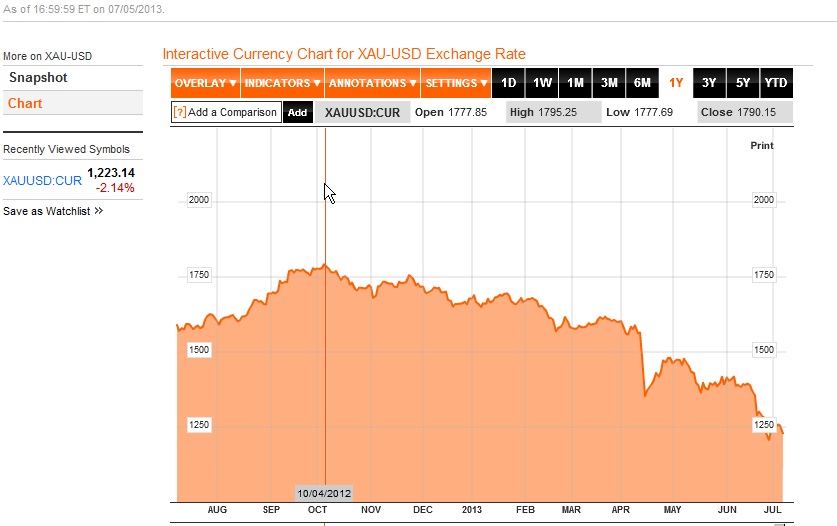
Ok in case you were wondering - I am not a moron. I did not really put my life savings into gold. But considering Glenn has nearly 1MM monthly listeners getting a constant dose of paranoia and gold-bug drivel I will bet that someone did exactly what I suggested in the above letter. Again I am not a moron, I did not invest in gold, and there is no hyperinflation. For more on this last point see Paul Krugman's response to Eric Erickson on the price of milk and bread (see here).
Actually to put this into perspective the writer of the fictitious letter above lost 1/3 of his savings over the last 9 months by investing in gold. How far back would we have to go in order for the loss due to inflation to be equal to a loss of 1/3 of savings? If you go back to June of 1996 the CPI was at 152. Today the CPI is at 231. Meaning that over the last 17 years a dollar has lost 1/3 of its purchasing power due to inflation (152/231 = .66). That is assuming you earned 0 interest on your savings.
Thursday, July 04, 2013
A hypothetical question about a hypothetical question...
First let me say that I have no evidence that this actually occurred. But it is my understanding that the Egyptian military and US military are pretty friendly. I wonder if the Egyptian military higher ups ran the idea of deposing President Morsi past their US counterparts? Not for approval but to see what the response would be. Something along the lines of "say we were to depose the president. Not that we are actually thinking about doing it. But just as a hypothetical. What would the backlash be. How negatively would it affect our relationship?" I have no idea if this actually happened but if it did I would be very curious as to what the response was...if it happened..which I have no evidence that it did.
Just Wondering...
From Washington Post June 18, 2013
Egypt appoints member of terror group that once massacred tourists to run tourism region
"It was only 16 years ago, in 1997, that members of an Egyptian militant group called Gamaa Islamiya stormed the ancient Temple of Hatshepsut in Luxor, a tourism magnet, and massacred 62 tourists before killing themselves, part of their insurgent campaign against the government. This week, Egyptian President Mohamed Morsi swore in Adel Mohamed al-Khayat, a former leader of Gamaa Islamiya and now a member of its political arm, as the new governor of Luxor governorate."
I wonder how much this incident contributed to the Egyptian military's willingness to overthrow President Morsi. Considering the Egyptian military spent years battling Gamaa Islamiya (see here) one could imagine how this appointment would have been received in the military camp. To be fair, al-Khayat resigned within a week but his appointment to this - of all possible positions - demonstrated incredible insensitivity.
Egypt appoints member of terror group that once massacred tourists to run tourism region
"It was only 16 years ago, in 1997, that members of an Egyptian militant group called Gamaa Islamiya stormed the ancient Temple of Hatshepsut in Luxor, a tourism magnet, and massacred 62 tourists before killing themselves, part of their insurgent campaign against the government. This week, Egyptian President Mohamed Morsi swore in Adel Mohamed al-Khayat, a former leader of Gamaa Islamiya and now a member of its political arm, as the new governor of Luxor governorate."
I wonder how much this incident contributed to the Egyptian military's willingness to overthrow President Morsi. Considering the Egyptian military spent years battling Gamaa Islamiya (see here) one could imagine how this appointment would have been received in the military camp. To be fair, al-Khayat resigned within a week but his appointment to this - of all possible positions - demonstrated incredible insensitivity.
Some thoughts on the Egyptian coup
I start from the premise that it is never a good thing for a democratically elected government be overthrown in a military coup.
However which of these two events was today's coup more like
Websters defines a constitution as either
Using this definition of constitution is is easy to see what went wrong with the drafting of the Egyptian Constitution. The document was written by a drafting committee made up predominantly of Muslim Brotherhood. When the constitution was put to a popular vote it received 63% of the vote but only 30% of the eligible population voted - meaning that only 19% of the eligible population voted in favor of the document. So large portions of the population did not in fact agree to the rules of the game. Even so last November President Morsi changed some of the rules of the game by announcing that his decrees were above judicial review.
Having said that I wonder if not for the bad state of the economy would Morsi still be in power. I tend to think yes. It was a combination of lack of legitimacy and deteriorating economic performance with no apparent plan for how to improve the situation - which pushed him out.
However which of these two events was today's coup more like
- A lightening bolt hits your house.
- A couple decides to divorce after a bad three year marriage.
Websters defines a constitution as either
- an established law or custom: ordinance
- the mode in which a state or society is organized; especially: the manner in which sovereign power is distributed
- the basic principles and laws of a nation, state, or social group that determine the powers and duties and the government and guarantee certain rights to the people in it
- a written instrument embodying the rules of a political or social organization
However my friend Leonard Wantchekon would argue that a constitution is not just a set of rules by which country is to be governed. Rather it is a set of rules for power sharing by which parties agree to band together to form a coalition. The rules contained within the constitution must be attractive enough to get all parties to agree to enter into the coalition. Some of the rather strange aspects of the the original Constitution of the United States (the Senate, the 2/3 person rule) were concessions to woo small states and slave holding southern states into the coalition. The US Civil War occurred when one party to the coalition (the Southern states) decided they no longer wanted to abide by the rules of the constitution and struck out on their own. Lincoln later used the opportunity of the war to redefine the rules of the constitution.
Using this definition of constitution is is easy to see what went wrong with the drafting of the Egyptian Constitution. The document was written by a drafting committee made up predominantly of Muslim Brotherhood. When the constitution was put to a popular vote it received 63% of the vote but only 30% of the eligible population voted - meaning that only 19% of the eligible population voted in favor of the document. So large portions of the population did not in fact agree to the rules of the game. Even so last November President Morsi changed some of the rules of the game by announcing that his decrees were above judicial review.
So is this more like the lightening bolt or the divorce?
Having said that I wonder if not for the bad state of the economy would Morsi still be in power. I tend to think yes. It was a combination of lack of legitimacy and deteriorating economic performance with no apparent plan for how to improve the situation - which pushed him out.
Wednesday, July 03, 2013
A truly strange response to a bit of good fortune...
The Republican Party has been saying that it wants to reach out to minority voters. So here is a most fortuitous opportunity. A minority woman, who is a former Miss America and a Harvard law school graduate, and is also a conservative.. says that she wants to run as a Republican candidate for the US House of Representatives 13th District of Illinois. If I were the party chair from her district I would be jumping up and down celebrating. Ok maybe not quite celebrating...the seat is currently held by a Republican but it is a swing district and the Ds are targeting it for the next election. Still I would be trying to nurture this candidate perhaps not for this seat and this race but for the future. But I guess that is where Montgomery County GOP Chairman Jim Allen I differ. Here is his exact response...
"Rodney Davis will win and the love child of the D.N.C. will be back in S—cago by May of 2014 working for some law firm that needs to meet their quota for minority hires. The truth is Nancy Pelosi and the DEMOCRAT party want this seat. So they called RINO Timmy Johnson to be their pack mule and get little queen to run. Ann Callis gets a free ride through a primary and Rodney Davis has a battle. The little queen touts her abstinence and she won the crown because she got bullied in school,,,boohoo..kids are cruel, life sucks and you move on..Now, miss queen is being used like a street walker and her pimps are the DEMOCRAT PARTY and RINO REPUBLICANS…These pimps want something they can’t get,,, the seat held by a conservative REPUBLICAN Rodney Davis and Nancy Pelosi can’t stand it...Little Queenie and Nancy Pelosi have so much in common but the one thing that stands out the most.. both are FORMER QUEENS, their crowns are tarnished and time has run out on the both of them..”"
Apparently that strategy didn't work so well as Jim Allen has resigned as Montgomery County Chair. Well if they need someone who is a bit more strategically savvy...I am available. lllinois 13 is on the southwest side of the city of Chicago. Btw her name is Erika Harold

"Rodney Davis will win and the love child of the D.N.C. will be back in S—cago by May of 2014 working for some law firm that needs to meet their quota for minority hires. The truth is Nancy Pelosi and the DEMOCRAT party want this seat. So they called RINO Timmy Johnson to be their pack mule and get little queen to run. Ann Callis gets a free ride through a primary and Rodney Davis has a battle. The little queen touts her abstinence and she won the crown because she got bullied in school,,,boohoo..kids are cruel, life sucks and you move on..Now, miss queen is being used like a street walker and her pimps are the DEMOCRAT PARTY and RINO REPUBLICANS…These pimps want something they can’t get,,, the seat held by a conservative REPUBLICAN Rodney Davis and Nancy Pelosi can’t stand it...Little Queenie and Nancy Pelosi have so much in common but the one thing that stands out the most.. both are FORMER QUEENS, their crowns are tarnished and time has run out on the both of them..”"
Apparently that strategy didn't work so well as Jim Allen has resigned as Montgomery County Chair. Well if they need someone who is a bit more strategically savvy...I am available. lllinois 13 is on the southwest side of the city of Chicago. Btw her name is Erika Harold

Monday, June 24, 2013

Thursday, June 13, 2013
That's really saying something...
Reuters: Arizona lawmakers pass Medicaid expansion
"I think that Obamacare is the biggest mistake that we've made in our country," said Republican State Senator Kelli Ward, who voted against the bill. "And bringing it into Arizona is the biggest mistake that we're going to make."
Ya know...I am going to disagree with her on this...Vietnam. The Gold Standard. Jim Crow. Male only sufferage. The have been some stinkers of policies in US history. But I am going with slavery as number one biggest policy mistake. You think about it... millions of persons who lived their life in servitude. The inhumane conditions of the slave ships. Hundreds of thousands killed or died of illness during the Civil War. Sen. Ward thinks Obamacare is going to be worse than that?..especially in Arizona? I don't know how they are planning to implement Obamacare in Arizona but I am sure glad I don't live there!
But good for Gov. Brewer.
"I think that Obamacare is the biggest mistake that we've made in our country," said Republican State Senator Kelli Ward, who voted against the bill. "And bringing it into Arizona is the biggest mistake that we're going to make."
Ya know...I am going to disagree with her on this...Vietnam. The Gold Standard. Jim Crow. Male only sufferage. The have been some stinkers of policies in US history. But I am going with slavery as number one biggest policy mistake. You think about it... millions of persons who lived their life in servitude. The inhumane conditions of the slave ships. Hundreds of thousands killed or died of illness during the Civil War. Sen. Ward thinks Obamacare is going to be worse than that?..especially in Arizona? I don't know how they are planning to implement Obamacare in Arizona but I am sure glad I don't live there!
But good for Gov. Brewer.
Friday, May 31, 2013
Hedge Hogs (not the cute prickly kind)
I just finished reading Hedge Hogs by Barbara Dreyfus. The book recounts the rise and fall of the Amaranth hedge fund and its star trader Brian Hunter. In the summer of 2006 Amaranth lost approximately USD 6BB trading natural gas. I have some personal interest in this story because at the time there were two other large hedge funds Centaurus and MotherRock also trading natural gas. The clearing firm that I worked for at the time had to deal with the blowout of MotherRock - which resulted in large part from Amaranth's enormous positions. This is a well written and fast paced book and it does well to capture the environment of the time as I remember it. I recommend it.
On page 139 of the book there is a passage that every risk manager should read and re-read and re-read again. This takes place during February of 2006. A that time, Hunter's positions were already extremely large and growing. He was making money. A lot of money.
Arora went to Jones to express his concerns over the size of Hunter's positions. A little while later he also brought it up with Maounis. "They reacted positively and told me they appreciated my input," Arora later said.
"Harry has a good nose for smelling danger," says an analyst who knows him. "Harry saw what Hunter was doing was so risky that it was dangerous."
But Hunter was minting money. "Most people were just amazed at how much money he was making," remembers a former Amaranth trader. "You don't want to kill the goose that lays the golden eggs. It was good for everyone when he was making money."
Other traders, back-office staff, and executives could see Hunter's profit-and-loss statements and could guess at the amount of money he traded. Some could see his spreadsheets. Other portfolio managers raised an eyebrow as they watched the volatility of his book. But there was little incentive to say anything. Everybody could see their bonuses growing. If Hunter was trading outsized positions, he was earning outsize profits - he earned the firm USD 320 million in February. He must know what he's doing, people told themselves.
"Human nature is such that when someone is making a lot of money, you don't question them," says another Amaranth trader.
Nothing was done about Arora's concerns.

On page 139 of the book there is a passage that every risk manager should read and re-read and re-read again. This takes place during February of 2006. A that time, Hunter's positions were already extremely large and growing. He was making money. A lot of money.
Arora went to Jones to express his concerns over the size of Hunter's positions. A little while later he also brought it up with Maounis. "They reacted positively and told me they appreciated my input," Arora later said.
"Harry has a good nose for smelling danger," says an analyst who knows him. "Harry saw what Hunter was doing was so risky that it was dangerous."
But Hunter was minting money. "Most people were just amazed at how much money he was making," remembers a former Amaranth trader. "You don't want to kill the goose that lays the golden eggs. It was good for everyone when he was making money."
Other traders, back-office staff, and executives could see Hunter's profit-and-loss statements and could guess at the amount of money he traded. Some could see his spreadsheets. Other portfolio managers raised an eyebrow as they watched the volatility of his book. But there was little incentive to say anything. Everybody could see their bonuses growing. If Hunter was trading outsized positions, he was earning outsize profits - he earned the firm USD 320 million in February. He must know what he's doing, people told themselves.
"Human nature is such that when someone is making a lot of money, you don't question them," says another Amaranth trader.
Nothing was done about Arora's concerns.
Monday, May 20, 2013
What Were They Thinking?
In my spare time I have been reading to take the PRM exams. There are four exams
China Aviation Oil (CAO) is a Singapore based company and subsidiary of China National Aviation Fuel Group. CAO was responsible for hedging airplane fuel (ie jet/kero) for airports in the PRC. Initially it just acted as a middle man between the markets and PRC airports- so it bought from the market and sold to PRC airports or visa-verse. It did not hold significant risk exposure itself. Eventually it began speculating on the direction of oil and fuel prices using future/swaps/and options...and they were not so good at speculating, as they lost USD 550 MM within a year on their spec positions. Obviously there was a supervisory problem there. However one of the reasons that the CAO derivatives disaster was not caught sooner was due to the incredible manner in which they were marking their option positions.
Quick review: (For option basics see here).
The current value of an option is typically broken into two parts; the INTRINSIC VALUE and the EXTRINSIC VALUE. The intrinsic value represents how much you would make if you exercised the option right now. So for a call that would be the current underlying price $S(t)$ minus the strike price$K$, and for a put option that would be the strike price $K$ minus the current underlying price $S(t)$. The extrinsic value just equals the current option price minus the intrinsic value
From the definition of Extrinsic Value above you can see that
If in the year 2023 I were to be studying for the PRM would I be reading about the risk management disasters of 2013 and saying "what were they thinking"? I sure hope not. In the same way that we learned from Barings, and Metallgesellschaft, and LTCM, I hope that we learn from today's disasters - with the caveat that maybe it will be obvious in hindsight but not in foresight. And then there was China Aviation Oil. What were they thinking?
- EXAM I: Finance Theory, Financial Instruments and Markets
- EXAM II: Mathematical Foundations of Risk Measurement
- EXAM III: Risk Management Practices
- EXAM IV: Case Studies, PRMIA Standards of Best Practice, Conduct and Ethics, Bylaw
China Aviation Oil (CAO) is a Singapore based company and subsidiary of China National Aviation Fuel Group. CAO was responsible for hedging airplane fuel (ie jet/kero) for airports in the PRC. Initially it just acted as a middle man between the markets and PRC airports- so it bought from the market and sold to PRC airports or visa-verse. It did not hold significant risk exposure itself. Eventually it began speculating on the direction of oil and fuel prices using future/swaps/and options...and they were not so good at speculating, as they lost USD 550 MM within a year on their spec positions. Obviously there was a supervisory problem there. However one of the reasons that the CAO derivatives disaster was not caught sooner was due to the incredible manner in which they were marking their option positions.
Quick review: (For option basics see here).
The current value of an option is typically broken into two parts; the INTRINSIC VALUE and the EXTRINSIC VALUE. The intrinsic value represents how much you would make if you exercised the option right now. So for a call that would be the current underlying price $S(t)$ minus the strike price$K$, and for a put option that would be the strike price $K$ minus the current underlying price $S(t)$. The extrinsic value just equals the current option price minus the intrinsic value
- Call:
- Intrinsic Value = $Max(S(t)-K,0)$
- Extrinsic Value =Option Price - Intrinsic Value
- Put:
- Intrinsic Value = $Max(K-S(t),0)$
- Extrinsic Value =Option Price - Intrinsic Value
From the definition of Extrinsic Value above you can see that
- Option Price = Intrinsic Value + Extrinsic Value
- Option Price = Intrinsic Value
If in the year 2023 I were to be studying for the PRM would I be reading about the risk management disasters of 2013 and saying "what were they thinking"? I sure hope not. In the same way that we learned from Barings, and Metallgesellschaft, and LTCM, I hope that we learn from today's disasters - with the caveat that maybe it will be obvious in hindsight but not in foresight. And then there was China Aviation Oil. What were they thinking?
Monday, May 13, 2013
Tragedy of the Metaphor
Talking Points Memo: Gallup Admits Mistakes, Plans Changes After Dismal 2012
"Gallup’s editor-in-chief Frank Newport wrote in an email published Monday by Politico that “a blue ribbon group of outside experts” is conducting a review of the firm’s “methodological issues” during the 2012 election."
No surprise there. Gallup had the worst polling performance in the 2012 presidential election (see here) What was a bit surprising was this metaphor later in the article.
"Weeks after the election, Newport wrote a post on the firm’s website in which he defended Gallup’s findings and appeared to take a thinly veiled shot at polling aggregators. “Individual farmers can each make a perfectly rational decision to graze their cows on the town commons,” Gallup wrote. “But all of these rational decisions together mean that the commons becomes overgrazed and, in the end, there is no grass left for any cow to graze. Many individual rational decisions can end up in a collective mess.” "
He seems to be referring to the tragedy of the commons (kind of). From Wikipedia
"In economics, the tragedy of the commons is the depletion of a shared resource by individuals, acting independently and rationally according to each one's self-interest, despite their understanding that depleting the common resource is contrary to the group's long-term best interests...The enclosure movement in England (which led to over 5000 Inclosure Acts between 1750 and 1860) prompted the analysis of this economic principle, probably known to Adam Smith.[1] In 1833 William Forster Lloyd published a pamphlet concerning European land tenure, specifically of herders sharing a common parcel of land, on which they are each entitled to let their cows graze. By this time, the English spinning and cloth-making industry had created an increased demand for wool. In English villages (as with mountain countries in Europe), shepherds had sometimes grazed their sheep in common areas, and sheep ate grass more severely than cows. Overgrazing could result because for each additional sheep, a herder could receive benefits, while the group shared damage to the commons. If all herders made this individually rational economic decision, the common could be depleted or even destroyed, to the detriment of all."
It's not clear exactly how that metaphor applies to the Gallup situation. A more apt metaphor for the current situation might be
"Farmer George makes a decision to plant his crops too close together. The other farmers tell him his plants won't grow well like that. Farmer George tells them he knows what he is doing and they are all wrong. When harvest time comes Farmer George gets a lousy crop yield. He then announces that he will convene a panel of agricultural experts to look into why his crop yield was poor. He finishes his pronouncement by incorrectly stating a metaphor about sheep and cows."

"Gallup’s editor-in-chief Frank Newport wrote in an email published Monday by Politico that “a blue ribbon group of outside experts” is conducting a review of the firm’s “methodological issues” during the 2012 election."
No surprise there. Gallup had the worst polling performance in the 2012 presidential election (see here) What was a bit surprising was this metaphor later in the article.
"Weeks after the election, Newport wrote a post on the firm’s website in which he defended Gallup’s findings and appeared to take a thinly veiled shot at polling aggregators. “Individual farmers can each make a perfectly rational decision to graze their cows on the town commons,” Gallup wrote. “But all of these rational decisions together mean that the commons becomes overgrazed and, in the end, there is no grass left for any cow to graze. Many individual rational decisions can end up in a collective mess.” "
He seems to be referring to the tragedy of the commons (kind of). From Wikipedia
"In economics, the tragedy of the commons is the depletion of a shared resource by individuals, acting independently and rationally according to each one's self-interest, despite their understanding that depleting the common resource is contrary to the group's long-term best interests...The enclosure movement in England (which led to over 5000 Inclosure Acts between 1750 and 1860) prompted the analysis of this economic principle, probably known to Adam Smith.[1] In 1833 William Forster Lloyd published a pamphlet concerning European land tenure, specifically of herders sharing a common parcel of land, on which they are each entitled to let their cows graze. By this time, the English spinning and cloth-making industry had created an increased demand for wool. In English villages (as with mountain countries in Europe), shepherds had sometimes grazed their sheep in common areas, and sheep ate grass more severely than cows. Overgrazing could result because for each additional sheep, a herder could receive benefits, while the group shared damage to the commons. If all herders made this individually rational economic decision, the common could be depleted or even destroyed, to the detriment of all."
It's not clear exactly how that metaphor applies to the Gallup situation. A more apt metaphor for the current situation might be
"Farmer George makes a decision to plant his crops too close together. The other farmers tell him his plants won't grow well like that. Farmer George tells them he knows what he is doing and they are all wrong. When harvest time comes Farmer George gets a lousy crop yield. He then announces that he will convene a panel of agricultural experts to look into why his crop yield was poor. He finishes his pronouncement by incorrectly stating a metaphor about sheep and cows."

Saturday, May 11, 2013
Yes THIS is News
A week ago we asked the question "but is it news"? The question was posed after two hours of viewing CNN's non-stop coverage of the aftermath of the Boston Marathon bombing. Since then CNN has moved their focus to the Cleveland kidnapping case. Again I ask - is it really "news"? Well maybe the initial story deserved a mention and certainly it is "news" for the families and friends of those involved. But for the common American what is the implication of this story? How different might your life be if this event had or had not occurred? It is certainly a horrible story - but there are a lot of horrible stories that go on in the world each day. CNN appears to be broadcasting a horror movie rather than real news story...perhaps they should have looked into how much the rights to Stephen King's movie Malice costs and run that instead. Again I ask - is it "news"?
There is however a news story going on today which could potentially have enormous impact on the future of American. And that is today's election in Pakistan. A quick review: Pakistan has a population of 180MM people (6th largest in the world) and a per capital GDP of USD 1,410. Their literacy rate is below 60% They currently suffer from a debilitating energy shortage, a separatist movement in one of their provinces (Baluchistan), rampant crime and gang wars which have killed 1000s of persons in their largest city Karachi, plus a Taliban insurgency. Perhaps this would not rise to the level of a horror movie except that Pakistan has nuclear weapons and Islamist sympathizers within their military.
The current government is headed by President Asif Ali Zardari the widowed husband of Benazir Bhutto. He is extremely unpopular with approval ratings in the teens. He and his party the secularist PPP are expected to lose in this election. The two parties who are expected to pick up votes are the nationalist PML-N party of Nawaz Sharif and the PTI party of former cricket star Imran Khan. Both have stated that they intend to be less supportive of the US and Khan has suggested that he would be willing to bargain with the TTP - the Pakistani Taliban.
This article by the CBC sums the situation up pretty well.
Here is today's NY Times coverage of the election. Turnout appears very high (which is good).
And here is a fascinating set of polls by the the Pew Center the major results of which are summarized in the following two table


This next table at first looks promising showing relatively low support for terror groups - until you realize that 13% of 180MM people is 23MM people who look favorably on Al Qaeda.

If there has been a major foreign policy failure of the Obama administration it has not been Syria or Bengazi or even North Korea (really what were we going to do there?) - it has been the continued deterioration of Pakistan. One wonders how much it would have cost the US to provide schooling for 10MM Pakistani children? Or to train 1MM Pakistani teachers? Or to subsidize natural gas imports from Qatar to alleviate their gas shortages. Like the Cleveland kidnapping story that CNN has been obsessed with, this situation could turn into a horror movie - but this is one that could have enormous implications for our future. And that is real "news".
There is however a news story going on today which could potentially have enormous impact on the future of American. And that is today's election in Pakistan. A quick review: Pakistan has a population of 180MM people (6th largest in the world) and a per capital GDP of USD 1,410. Their literacy rate is below 60% They currently suffer from a debilitating energy shortage, a separatist movement in one of their provinces (Baluchistan), rampant crime and gang wars which have killed 1000s of persons in their largest city Karachi, plus a Taliban insurgency. Perhaps this would not rise to the level of a horror movie except that Pakistan has nuclear weapons and Islamist sympathizers within their military.
The current government is headed by President Asif Ali Zardari the widowed husband of Benazir Bhutto. He is extremely unpopular with approval ratings in the teens. He and his party the secularist PPP are expected to lose in this election. The two parties who are expected to pick up votes are the nationalist PML-N party of Nawaz Sharif and the PTI party of former cricket star Imran Khan. Both have stated that they intend to be less supportive of the US and Khan has suggested that he would be willing to bargain with the TTP - the Pakistani Taliban.
This article by the CBC sums the situation up pretty well.
Here is today's NY Times coverage of the election. Turnout appears very high (which is good).
And here is a fascinating set of polls by the the Pew Center the major results of which are summarized in the following two table
This next table at first looks promising showing relatively low support for terror groups - until you realize that 13% of 180MM people is 23MM people who look favorably on Al Qaeda.
If there has been a major foreign policy failure of the Obama administration it has not been Syria or Bengazi or even North Korea (really what were we going to do there?) - it has been the continued deterioration of Pakistan. One wonders how much it would have cost the US to provide schooling for 10MM Pakistani children? Or to train 1MM Pakistani teachers? Or to subsidize natural gas imports from Qatar to alleviate their gas shortages. Like the Cleveland kidnapping story that CNN has been obsessed with, this situation could turn into a horror movie - but this is one that could have enormous implications for our future. And that is real "news".
Friday, May 10, 2013
US Job Market
Recent news stories (see here ) have suggested that the job market is improving. A cursory look at a plot of the Civilian Unemployment Rate seems to support that hypothesis:


Most other possible influences on the employment-population ratio also appear unlikely to have contributed to the 1999–2007 decline. Federal income tax rates fell rather than rose, other federal tax rates did not rise, and federal transfer programs did not change in structure or in patterns of growth that line up with the employment declines, although further study of the Supplemental Nutrition Assistance Program and
the Social Security disability insurance program would be worthwhile. Changes in health status, the minimum wage, and other factors also appear to have played no role, although rising rates of incarceration among disadvantaged and younger men may have contributed. Whether changes in time use and home production accompanied the employment declines is not answerable with the available data but remains a possibility. Further analysis of possible contributors to the employment decline is clearly needed. Most other possible influences on the employment-population ratio also appear unlikely to have contributed to the 1999–2007 decline. Federal income tax rates fell rather than rose, other federal tax rates did not rise, and federal transfer programs did not change in structure or in patterns of growth that line up with the employment declines, although further study of the Supplemental Nutrition Assistance Program and the Social Security disability insurance program would be worthwhile. Changes in health status, the minimum wage, and other factors also appear to have played no role, although rising rates of incarceration among disadvantaged and younger men may have contributed. Whether changes in time use and home production accompanied the employment declines is not answerable with the available data but remains a possibility. Further analysis of possible contributors to the employment decline is clearly needed.


But is the labor market situation really improving that much? Recall how the unemployment rate is defined.
Start with the entire population (POP)
The Civilian Population (CIVPOP) is defined as the Population (POP) minus persons who are either
- under the age of 16
- in a correctional facility, residential nursing facility, or mental health care facility
- on active military duty.
The Civilian Labor Force (CIVLF) is defined as the Civilian Population (CIVPOP) minus persons who are jobless and also are not looking for a job. The Civilian Labor Force (CIVLF) is meant to define the pool of persons who are either employed or actively looking for work ie the active labor force.
The Civilian Labor Force (CIVLF) can then be divided into those who are currently employed (E) and those who are not employed but are looking for jobs and are available for work ie the unemployed (U).
Finally the Civilian Unemployment Rate is defined as U / (E+U) or alternately as U / (CIVLF)
While this definition may correctly represent the percent of potential workers who are actively looking for jobs it is less useful as a gauge of the health of the economy. First there is a small problem that the Civilian Labor Force starts by excluding those who are either below the age of 16, institutionalized,or on military duty. Over long periods the proportion of the population who fit into one of those categories can vary. That is more a long term trend problem though.
The much larger problem however is that persons who are jobless but NOT looking for jobs are not included in the Civilian Labor Force. Look at the definition of CIVLF again. And the proportion of persons who fall into this category can vary greatly over the business cycle. Below is a graph of the Labor Force Participation Rate ie CIVLF / CIVPOP. You can see that it fell 1% between 1999 and 2007 and an additional 2% since 2007.

But even that graph does not tell us the full story because as was explained above the denominator CIVPOP excludes a significant number of persons to start with. So where to go for a holistic picture of the labor market? Many economists suggest that the Employment to Population Ratio ie E / POP is a cleanest picture of the labor market. And the Employment / Population Ratio is telling us a very different story than the Civilian Unemployment Rate.


* One of the interesting points to note in this graph is the Employment / Population ratio started falling in 1999 and then experienced a major drop with the onset of the Great Recession in 2007. Here labor economist Robert Moffitt tries to explain the decline in the Employment / Population which occurred between 1999 and 2007. From the summary of his paper.
"The decline in the employment-population ratios for men and women during 1999–2007, before the Great Recession, represents a historic turnaround. The decline was disproportionately concentrated in the less
educated and younger groups within both the male and the female populations and, within the latter, among unmarried women, especially those without children. A standard model that emphasizes the role of wage rates and nonlabor income can explain about half the decline for men but none of it for women, whose wages rose, on average and across all subgroups, over the period. However, separate examination of trends in wages and employment for married and unmarried women, and for unmarried women with and without children, finds a more important role for wages. The decline in female employment was by far the largest for unmarried women without children, and wages for that group declined over 1999–2007. However, the
different trends in wage rates and other determinants of employment for these different demographic subgroups raise many questions that need to be explored.
educated and younger groups within both the male and the female populations and, within the latter, among unmarried women, especially those without children. A standard model that emphasizes the role of wage rates and nonlabor income can explain about half the decline for men but none of it for women, whose wages rose, on average and across all subgroups, over the period. However, separate examination of trends in wages and employment for married and unmarried women, and for unmarried women with and without children, finds a more important role for wages. The decline in female employment was by far the largest for unmarried women without children, and wages for that group declined over 1999–2007. However, the
different trends in wage rates and other determinants of employment for these different demographic subgroups raise many questions that need to be explored.
Most other possible influences on the employment-population ratio also appear unlikely to have contributed to the 1999–2007 decline. Federal income tax rates fell rather than rose, other federal tax rates did not rise, and federal transfer programs did not change in structure or in patterns of growth that line up with the employment declines, although further study of the Supplemental Nutrition Assistance Program and
the Social Security disability insurance program would be worthwhile. Changes in health status, the minimum wage, and other factors also appear to have played no role, although rising rates of incarceration among disadvantaged and younger men may have contributed. Whether changes in time use and home production accompanied the employment declines is not answerable with the available data but remains a possibility. Further analysis of possible contributors to the employment decline is clearly needed. Most other possible influences on the employment-population ratio also appear unlikely to have contributed to the 1999–2007 decline. Federal income tax rates fell rather than rose, other federal tax rates did not rise, and federal transfer programs did not change in structure or in patterns of growth that line up with the employment declines, although further study of the Supplemental Nutrition Assistance Program and the Social Security disability insurance program would be worthwhile. Changes in health status, the minimum wage, and other factors also appear to have played no role, although rising rates of incarceration among disadvantaged and younger men may have contributed. Whether changes in time use and home production accompanied the employment declines is not answerable with the available data but remains a possibility. Further analysis of possible contributors to the employment decline is clearly needed.
In 2008, with the onset of the Great Recession, the employment-population ratio plummeted, falling to approximately 72 percent for men and 63 percent for women in 2009. It has exhibited a slow recovery since that time. Given the downward trend in the ratio before the Great Recession, a natural question is whether it will return to its 2007 level after the recovery is complete, or only to a lower level. The model estimated in this paper can be used to forecast employment-population ratios in 2011, the latest year for which CPS data are available. The results suggest that the ratios may fully return to their 2007 levels."
Thursday, May 09, 2013
But Is It News?
A week or so ago I had CNN on my TV for approximately two hours. Within a two hour span there were at least a half dozen breaking stories related to the Boston Marathon Bombing. The odd part was that there was almost no news in the stories...or at least nothing that I would consider "news". here are some of the breaking news stories that they were first to report on.
(1) The surviving bomber was moved from Beth Israel Deaconess Medical Center to a prison hospital.
(2) The bomber's mother had a press conference in which she said she thought her sons were innocent.
(3) A Congressman said that giving the suspect his Miranda Rights was bad decision
(4) One of the victims decided to have her leg amputated.
I am sure I am forgetting some of the breaking "news" stories. It was two hours of continuous coverage of the Boston Marathon Bombing situation. Perhaps I am being a bit too demanding here, and I am sure I am not the first to mention this, but was any of this "news"? Let's look at the first "news" story as an example.
(1) The surviving bomber was moved from Beth Israel Deaconess Medical Center to a prison hospital.
What is the impact of this story on me, or anyone I know, or to the world in general if he was moved? And what would be the implications if he was not moved? The reporter is disseminating a piece of information but the information doesn't have any obvious implications. Maybe for the doctors and police officers involved there was some implication - but for no one else. Is this really "news" then? I think of "news" as new information that has some impact on me, or people who I know, or the world in general. Let's see how Merriam-Webster defines news
Definition of NEWS
1 a : a report of recent events
1 b : previously unknown information <I've got news for you>
1 c : something having a specified influence or effect <the rain was good news for lawns and gardens — Garrison Keillor> <the virus was bad news>
2 a : material reported in a newspaper or news periodical or on a newscast
2 b : matter that is newsworthy
3 : newscast
Definition 3 just equates news to a newscast. That definition does not help define what is "news" for us. Likewise definition 2a defines news as any material reported from a news source. By that definition if CNN had decided to report on what I had for lunch that would be news as well. I don't think of what I had for lunch as "news". Definitions 1a and 1b have the same problem. If CNN told you what I had for lunch today that would be a report of recent events and it would be information which was previously unknown to you - but you probably don't care either. That is not "news" in the sense that I am looking for. Definition 1c is a different usage of the word "news" . That leaves definition 2b. 2b equates news to a matter that is newsworthy. So lets check the definition of newsworthy.
: interesting enough to the general public to warrant reporting
So by this definition if the public is interested in the matter then it is news. So maybe I am wrong. If the public is interested in what kind of shoes Lindsey Lohan wore last night or a two headed cow or even what I had for lunch today then that would be news. Still I go back to my definition of what is news "news = new information that has some impact on me, or people who I know, or the world in general. " And by this definition I did not see much "news" in the CNN breaking news reports.
(1) The surviving bomber was moved from Beth Israel Deaconess Medical Center to a prison hospital.
(2) The bomber's mother had a press conference in which she said she thought her sons were innocent.
(3) A Congressman said that giving the suspect his Miranda Rights was bad decision
(4) One of the victims decided to have her leg amputated.
I am sure I am forgetting some of the breaking "news" stories. It was two hours of continuous coverage of the Boston Marathon Bombing situation. Perhaps I am being a bit too demanding here, and I am sure I am not the first to mention this, but was any of this "news"? Let's look at the first "news" story as an example.
(1) The surviving bomber was moved from Beth Israel Deaconess Medical Center to a prison hospital.
What is the impact of this story on me, or anyone I know, or to the world in general if he was moved? And what would be the implications if he was not moved? The reporter is disseminating a piece of information but the information doesn't have any obvious implications. Maybe for the doctors and police officers involved there was some implication - but for no one else. Is this really "news" then? I think of "news" as new information that has some impact on me, or people who I know, or the world in general. Let's see how Merriam-Webster defines news
Definition of NEWS
1 a : a report of recent events
1 b : previously unknown information <I've got news for you>
1 c : something having a specified influence or effect <the rain was good news for lawns and gardens — Garrison Keillor> <the virus was bad news>
2 a : material reported in a newspaper or news periodical or on a newscast
2 b : matter that is newsworthy
3 : newscast
Definition 3 just equates news to a newscast. That definition does not help define what is "news" for us. Likewise definition 2a defines news as any material reported from a news source. By that definition if CNN had decided to report on what I had for lunch that would be news as well. I don't think of what I had for lunch as "news". Definitions 1a and 1b have the same problem. If CNN told you what I had for lunch today that would be a report of recent events and it would be information which was previously unknown to you - but you probably don't care either. That is not "news" in the sense that I am looking for. Definition 1c is a different usage of the word "news" . That leaves definition 2b. 2b equates news to a matter that is newsworthy. So lets check the definition of newsworthy.
: interesting enough to the general public to warrant reporting
So by this definition if the public is interested in the matter then it is news. So maybe I am wrong. If the public is interested in what kind of shoes Lindsey Lohan wore last night or a two headed cow or even what I had for lunch today then that would be news. Still I go back to my definition of what is news "news = new information that has some impact on me, or people who I know, or the world in general. " And by this definition I did not see much "news" in the CNN breaking news reports.
Monday, April 29, 2013
Obies in the news
Nice to see my fellow Oberlin College classmate with such a "progressive" view.. Ah and no shock...fellow Obie Michelle Malkin comes to his aid. It is always a sign that you said something stupid when Michelle Malkin is called in to defend you. How long will it take before Sarah Palin chimes in to defend his 1st Amendment rights?
big world
Someone asked me why I was so interested in Egypt. There are two reasons (1) they are attempting to prevent a run on a currency by engineering a controlled devaluation. That is a difficult task and it is still to be seen if they can do it. Latest update here (2) they are the big player in the Mid East and what happens there could have significant ripples.
Sometimes we forget how big a world it is. Below is a graph of the worlds 20 most populous countries

Now plot the nominal GDPs of those same 20 countries.

Finally plot the per capita GDPs of those same 20 most populace countries

The results are pretty stark. The US, Japan, and Germany stand out as the wealthy countries. There is a second group Brazil, Russia, Mexico, Turkey whose per capita GDPs all sit around 10,000 USD. One more tier down are China, Iran, and Thailand. Then there are the other ten countries all with per capita GDPs below 4,000 USD. India with a population over three times that of the US has a per capita income of approximately 5% of the US. Pakistan plus Bangladesh has a population equal to the US and yet their combined GDP barely register.
Sometimes we forget how big a world it is. Below is a graph of the worlds 20 most populous countries

Now plot the nominal GDPs of those same 20 countries.


Finally plot the per capita GDPs of those same 20 most populace countries

The results are pretty stark. The US, Japan, and Germany stand out as the wealthy countries. There is a second group Brazil, Russia, Mexico, Turkey whose per capita GDPs all sit around 10,000 USD. One more tier down are China, Iran, and Thailand. Then there are the other ten countries all with per capita GDPs below 4,000 USD. India with a population over three times that of the US has a per capita income of approximately 5% of the US. Pakistan plus Bangladesh has a population equal to the US and yet their combined GDP barely register.
Subscribe to:
Posts (Atom)